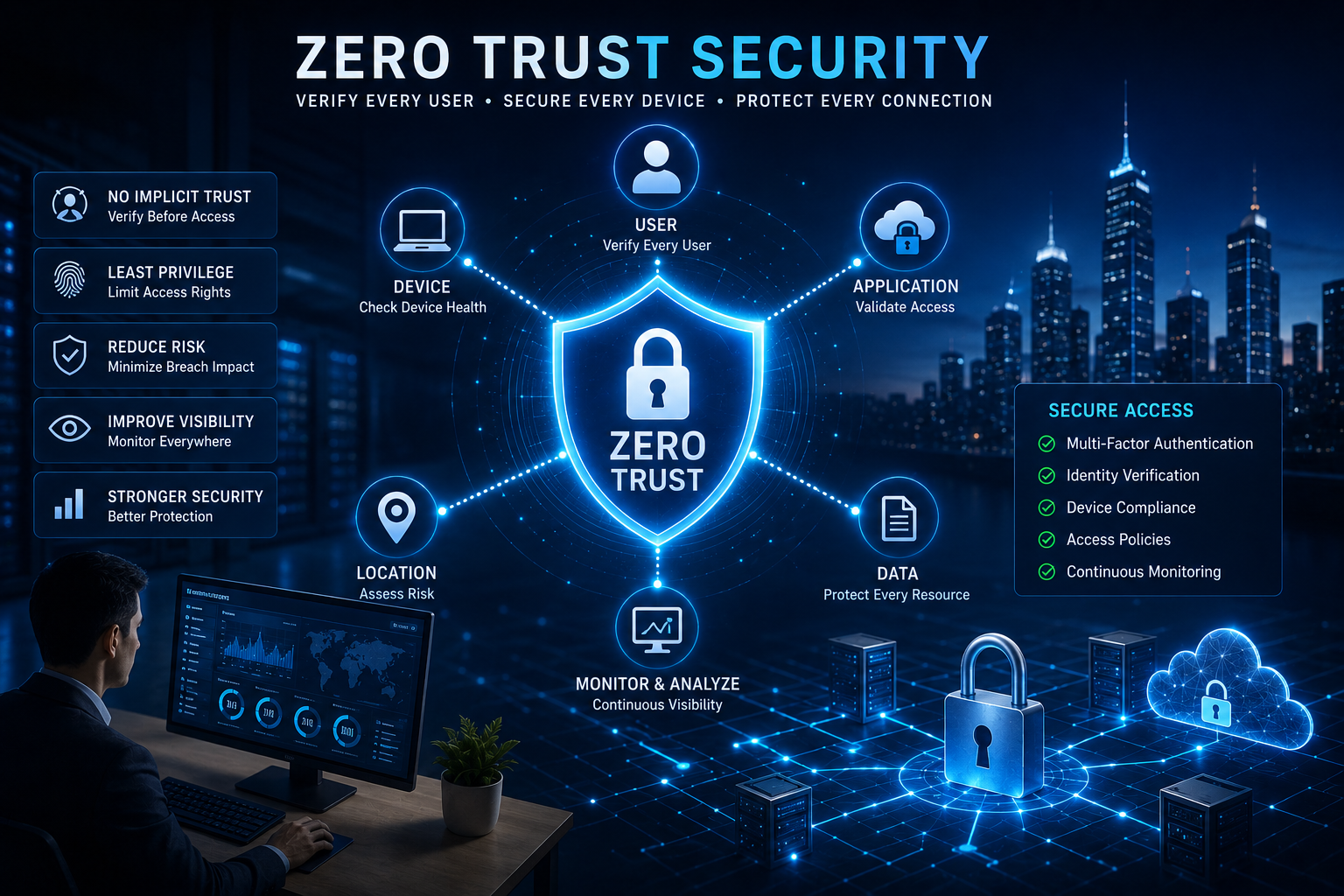
Enterprise networks are no longer limited to employees working from a corporate office. Employees connect from branch offices, homes, public networks, mobile devices, and cloud environments every day. At the same time, businesses depend on SaaS applications, cloud platforms, connected devices, and third-party services.
This expanded digital environment has made traditional perimeter-based security increasingly difficult to manage. Once an attacker gains access to the network, traditional security models can make it easier to move between systems and access sensitive resources.
Zero Trust Network Security takes a different approach. Instead of automatically trusting users or devices because they are inside the network, Zero Trust continuously verifies identity, device security, access permissions, and network activity.
This guide explains how Zero Trust works, why enterprises are adopting it, and the best practices businesses should follow when building a modern Zero Trust security strategy.
What Is Zero Trust Network Security?
Zero Trust is a security model based on a simple principle: no user, device, application, or connection should be trusted automatically.
Every access request must be verified before access is granted. Authentication, authorization, device posture, location, application requirements, and other security signals can be evaluated before allowing access to business resources.
Unlike traditional security models that focus heavily on protecting the network perimeter, Zero Trust focuses on protecting individual resources and controlling access at every stage.
This approach is particularly valuable for organizations operating across multiple offices, cloud environments, remote locations, and hybrid infrastructures.
Why Traditional Network Security Is No Longer Enough
Traditional enterprise security often assumes that users and devices inside the corporate network can be trusted.
However, modern businesses operate across a much larger digital environment.
Employees may access company applications from personal networks. Cloud applications may operate outside traditional data centers. Third-party vendors may require controlled access to specific systems. Mobile devices can connect from almost anywhere.
A compromised account or device can therefore become a serious security risk.
Zero Trust reduces this risk by limiting access based on verified identity, device security, business requirements, and least-privilege principles.
Core Principles of Zero Trust
A successful Zero Trust strategy is built around several important principles.
Verify Every Access Request
Every user and device should be authenticated and authorized before accessing business resources.
Authentication should not be treated as a one-time event. Organizations can continuously evaluate access based on changing security conditions.
Apply Least-Privilege Access
Users should receive only the access required to perform their responsibilities.
For example, an employee who only needs access to a specific cloud application should not automatically receive access to an entire corporate network.
Least-privilege access reduces the potential impact of compromised accounts.
Secure Every Device
User identity alone is not enough.
Organizations should evaluate device security before granting access. Factors such as operating system version, security updates, endpoint protection, encryption, and device compliance can help determine whether a device should be trusted.
Segment Critical Resources
Network segmentation separates important systems and applications into controlled security zones.
If one system is compromised, segmentation can prevent attackers from easily moving toward sensitive applications, databases, and infrastructure.
Continuously Monitor Activity
Zero Trust requires continuous visibility.
Organizations should monitor authentication events, network traffic, application access, device activity, and unusual behavior to identify potential threats quickly.
How Zero Trust Works With Modern Enterprise Networking
Zero Trust does not replace enterprise networking. Instead, it works alongside technologies that provide secure and reliable connectivity.
SD-WAN can provide intelligent connectivity between branches, cloud platforms, and data centers.
Secure Access Service Edge can combine networking and security capabilities closer to users and applications.
Cloud security platforms can protect workloads and applications operating across different cloud environments.
Identity and access management systems can control who is allowed to access specific resources.
Together, these technologies create a more secure and flexible enterprise infrastructure.
Benefits of Zero Trust for Enterprises
Implementing Zero Trust can provide several important business benefits.
Organizations gain better visibility into users, devices, applications, and network activity.
Security teams can reduce unnecessary access and limit the potential impact of compromised credentials.
Remote and hybrid employees can securely access business applications without depending entirely on traditional network boundaries.
Businesses can also simplify security policies across branch offices, cloud environments, and remote users.
Most importantly, Zero Trust creates a security architecture designed around modern business operations rather than an outdated perimeter.
Best Practices for Implementing Zero Trust
Businesses should avoid attempting to transform their entire infrastructure at once.
Start by identifying critical applications, users, devices, and sensitive data.
Next, establish clear identity and access policies based on business requirements.
Introduce least-privilege access and gradually remove unnecessary permissions.
Segment sensitive systems and applications to reduce lateral movement.
Monitor network and user activity continuously.
Finally, regularly review access policies and update them as business requirements change.
A phased approach allows organizations to improve security without creating unnecessary operational disruption.
Why Zero Trust Matters for Future-Ready Businesses
As cloud adoption, remote work, SaaS applications, and connected devices continue to grow, traditional network boundaries will become even less meaningful.
Businesses need security architectures that can protect users and resources regardless of where they are located.
Zero Trust provides a framework for achieving this by combining identity verification, least-privilege access, continuous monitoring, segmentation, and modern security technologies.
Organizations that adopt Zero Trust can build stronger security foundations while maintaining the flexibility required for digital transformation.
Why Choose Qsera for Secure Enterprise Networking
Building a Zero Trust environment requires more than deploying individual security products. It requires a coordinated approach across connectivity, security, cloud infrastructure, access control, and monitoring.
Qsera helps businesses design secure and reliable enterprise networking environments that support modern digital operations.
Our networking capabilities include Dedicated Internet Access, SD-WAN, MPLS connectivity, cloud networking, managed network services, cybersecurity integration, proactive monitoring, and business continuity solutions.
Our team can evaluate existing infrastructure, identify security and connectivity gaps, and help organizations develop a scalable architecture designed around their business requirements.
Conclusion
Zero Trust Network Security is becoming an essential component of modern enterprise infrastructure. By continuously verifying access, applying least-privilege principles, securing devices, segmenting critical resources, and monitoring activity, businesses can significantly strengthen their security posture.
The goal is not simply to build a stronger network perimeter. It is to create an environment where every connection is evaluated and every resource is protected.
With the right strategy and networking partner, organizations can adopt Zero Trust while maintaining reliable connectivity, operational efficiency, and the flexibility required for future growth.
Frequently Asked Questions
Common questions about this topic.
Zero Trust Network Security is a security approach where users, devices, and connections are continuously verified before accessing business resources. It follows the principle that no connection should automatically be trusted.
No. Zero Trust can benefit businesses of different sizes. Smaller organizations can also use identity-based access, multi-factor authentication, device security, and least-privilege policies to strengthen their infrastructure.
No. Zero Trust does not necessarily replace firewalls. Instead, it adds additional identity, access-control, segmentation, and monitoring capabilities to create a more comprehensive security architecture.
Yes. Zero Trust is particularly useful for remote and hybrid environments because access can be controlled based on user identity, device security, application requirements, and other security factors rather than simply relying on whether someone is connected to the corporate network.
Qsera can help organizations evaluate their existing network infrastructure and develop secure enterprise connectivity strategies that incorporate technologies such as SD-WAN, Dedicated Internet Access, cloud networking, managed services, cybersecurity integration, and proactive monitoring.
Ready to Build a Better Network?
Talk to Qsera's enterprise networking experts about the right connectivity solution for your business.
More insights on enterprise networking and connectivity.
UncategorizedAugust 20, 2026 6 min read
Network Automation in 2026: How Enterprises Can Build Smarter, Faster, and More Reliable Networks
Introduction Enterprise networks are becoming increasingly complex. Businesses now operate across multiple offices, cloud platforms, data centers, remote locations, applications, and connected devices. Managing this infrastructure manually can become time-consuming and difficult to scale. IT teams may spend significant time configuring devices, troubleshooting connectivity problems, monitoring traffic, and responding to repetitive network issues. Network automation […]
UncategorizedAugust 18, 2026 8 min read
Fast Internet Isn’t Enough: The Hidden Network Problems Slowing Down Your Business
Introduction A fast internet connection sounds like the obvious solution to a slow business network. But in modern enterprise environments, bandwidth is only one part of the performance equation. A business can have a high-speed internet connection and still experience slow cloud applications, delayed video calls, poor VoIP quality, inconsistent application performance, and frustrating connectivity […]
UncategorizedAugust 13, 2026 7 min read
Why Network Downtime Is Costing Enterprises More Than Ever And How to Prevent It
Introduction Network connectivity has become a critical part of modern business operations. Employees depend on reliable networks to access cloud applications, communicate with customers, collaborate with teams, process transactions, and manage day-to-day operations. When the network goes down, even for a short period, business productivity can quickly come to a standstill. Network downtime can result […]