As businesses become more connected through cloud computing, remote work, and digital collaboration, cybersecurity has become one of the most important aspects of enterprise networking. Every connected device, branch office, employee, and cloud application creates new opportunities for cyber threats. Organizations must protect their networks not only from external attacks but also from internal vulnerabilities that could compromise sensitive business data.
A strong cybersecurity strategy helps businesses maintain customer trust, protect confidential information, and ensure uninterrupted business operations. Modern enterprise networking requires security to be integrated into every layer of the infrastructure rather than treated as an afterthought. This guide explores the importance of cybersecurity in enterprise networking and the best practices organizations should adopt to reduce risk and strengthen their digital infrastructure.
Understanding Enterprise Network Security
Enterprise network security is the process of protecting an organization’s network infrastructure, connected devices, applications, and data from unauthorized access, cyberattacks, and malicious activity.
Unlike traditional security models that focused only on perimeter protection, modern enterprise security combines multiple technologies to secure users, devices, cloud platforms, and business applications regardless of where they are located.
An effective enterprise security strategy includes firewalls, intrusion detection systems, endpoint protection, encrypted communications, secure remote access, identity management, and continuous monitoring to protect business operations.
Common Cybersecurity Threats Facing Businesses
Cyber threats continue to evolve as attackers become more sophisticated. Organizations of every size face risks that can disrupt operations and expose confidential information.
Ransomware attacks encrypt business data and demand payment for recovery.
Phishing campaigns trick employees into revealing sensitive credentials or financial information.
Distributed denial of service attacks overload business networks, making online services unavailable.
Insider threats caused by accidental mistakes or unauthorized access can expose critical business information.
Weak passwords, outdated software, and unpatched systems also create vulnerabilities that cybercriminals actively target.
Understanding these threats allows businesses to implement stronger security controls before incidents occur.
Best Practices for Securing Enterprise Networks
Building a secure enterprise network requires multiple layers of protection working together.
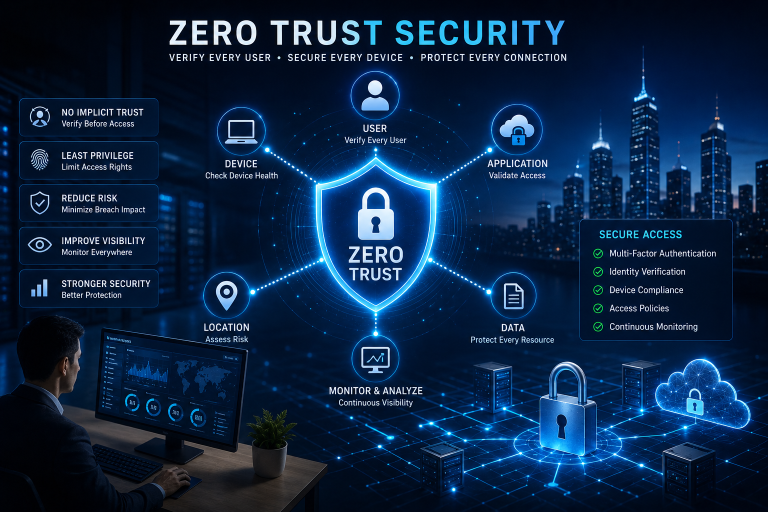
Organizations should implement Zero Trust security principles that verify every user and device before granting access to business resources.
Multi factor authentication adds an additional layer of protection for employee accounts and remote access.
Network segmentation limits the spread of cyber threats by separating critical systems from general network traffic.
Regular software updates and security patches help eliminate known vulnerabilities before attackers can exploit them.
Continuous network monitoring provides real time visibility into suspicious activity, allowing security teams to respond quickly and minimize potential damage.
Employee awareness training is equally important because informed users are often the first line of defense against phishing and social engineering attacks.
Business Benefits of Strong Cybersecurity
Investing in cybersecurity provides long term business value beyond preventing attacks.
Organizations strengthen customer confidence by demonstrating a commitment to protecting sensitive information.
Reliable security reduces downtime caused by cyber incidents and helps maintain uninterrupted business operations.
Compliance with industry regulations becomes easier when security controls are properly implemented and documented.
Employees can collaborate securely from any location while accessing cloud applications and business systems without unnecessary risk.
Strong cybersecurity also supports digital transformation by providing a secure foundation for cloud adoption, remote work, and enterprise connectivity.
Why Choose Qsera for Secure Enterprise Networking
Protecting modern business networks requires expertise, proactive monitoring, and enterprise grade infrastructure. Qsera delivers secure networking solutions designed to help organizations reduce cyber risks while maintaining high performance and reliability.
Our services include secure Dedicated Internet Access, SD WAN deployment, MPLS connectivity, cloud networking, managed network services, firewall integration, proactive monitoring, and business continuity planning.
We work closely with businesses to evaluate security risks, strengthen network infrastructure, and implement scalable solutions that support long term growth.
Conclusion
Cybersecurity is no longer optional for modern enterprises. Every connected device, employee, and cloud application increases the importance of protecting business networks against evolving cyber threats. Organizations that invest in layered security, continuous monitoring, and modern enterprise networking create a resilient foundation for growth while maintaining customer trust and operational continuity. With Qsera as your technology partner, your business can confidently build a secure, reliable, and future ready enterprise network.
Frequently Asked Questions
Common questions about this topic.
Enterprise network security is the practice of protecting business networks, connected devices, applications, and data from cyber threats, unauthorized access, and security breaches.
Cybersecurity protects sensitive business information, reduces downtime, strengthens customer trust, and ensures reliable business operations in an increasingly connected environment.
Common threats include ransomware, phishing attacks, distributed denial of service attacks, insider threats, malware, and unauthorized access attempts.
Organizations should implement Zero Trust security, multi factor authentication, network segmentation, continuous monitoring, employee security training, and regular software updates.
Qsera provides secure networking solutions including Dedicated Internet Access, SD WAN, MPLS, cloud connectivity, managed network services, proactive monitoring, and enterprise security expertise to help businesses protect their digital infrastructure.
Ready to Build a Better Network?
Talk to Qsera's enterprise networking experts about the right connectivity solution for your business.
More insights on enterprise networking and connectivity.
UncategorizedAugust 27, 2026 7 min read
SD-WAN vs MPLS: Which Network Strategy Is Right for Your Business in 2026?
Introduction Enterprise networking has changed significantly as businesses move more applications, workloads, and collaboration tools to the cloud. Organizations now need reliable connectivity between offices, remote employees, data centers, cloud platforms, and business applications. For many years, MPLS has been a preferred technology for connecting enterprise locations. However, SD-WAN has emerged as a flexible alternative […]
UncategorizedAugust 25, 2026 5 min read
Zero Trust Network Security: How Modern Enterprises Can Secure Every User, Device, and Connection
Introduction Enterprise networks are no longer limited to employees working from a corporate office. Employees connect from branch offices, homes, public networks, mobile devices, and cloud environments every day. At the same time, businesses depend on SaaS applications, cloud platforms, connected devices, and third-party services. This expanded digital environment has made traditional perimeter-based security increasingly […]
UncategorizedAugust 20, 2026 6 min read
Network Automation in 2026: How Enterprises Can Build Smarter, Faster, and More Reliable Networks
Introduction Enterprise networks are becoming increasingly complex. Businesses now operate across multiple offices, cloud platforms, data centers, remote locations, applications, and connected devices. Managing this infrastructure manually can become time-consuming and difficult to scale. IT teams may spend significant time configuring devices, troubleshooting connectivity problems, monitoring traffic, and responding to repetitive network issues. Network automation […]