Enterprise networks are no longer confined to offices, private data centers, and controlled corporate environments. Employees work from different locations, applications run across cloud platforms, and businesses increasingly depend on secure access to digital resources from anywhere.
Traditional network security models were designed around a defined perimeter, where users and applications were protected by centralized firewalls, VPNs, and data-center-based infrastructure. As enterprise environments become more distributed, maintaining this model can introduce complexity, performance limitations, and visibility challenges.
Secure Access Service Edge (SASE) provides a modern approach by bringing networking and security capabilities together through a cloud-centric architecture. For organizations adopting cloud applications, hybrid work, and distributed operations, understanding the differences between SASE and traditional network security is becoming increasingly important.
Understanding Traditional Network Security
Traditional enterprise security typically relies on a centralized security perimeter. Traffic from branch offices, remote users, and other locations may be routed through corporate data centers or centralized security appliances before reaching applications and services.
Common technologies include:
Firewalls
VPNs
Intrusion prevention systems
Secure web gateways
MPLS connectivity
Network access controls
This approach can work effectively for organizations with centralized applications and predictable traffic patterns. However, modern cloud adoption and distributed workforces have created new challenges.
When users access cloud applications directly from different locations, routing traffic through a centralized data center can introduce additional latency and unnecessary network complexity.
What Is SASE?
Secure Access Service Edge (SASE) is a modern networking and security architecture that combines connectivity and security capabilities through cloud-based services.
A SASE architecture can bring together:
SD-WAN
Zero Trust Network Access
Secure Web Gateway
Cloud Access Security Broker
Next-Generation Firewall
Cloud-based security controls
Instead of relying entirely on a centralized security perimeter, SASE enables organizations to apply security policies closer to users, devices, applications, and locations.
This makes SASE particularly relevant for businesses operating across multiple offices, cloud environments, and remote work locations.
SASE vs Traditional Network Security
The biggest difference between the two approaches is how security and connectivity are delivered.
Traditional network security generally focuses on protecting a defined corporate perimeter, while SASE is designed around secure access to applications and resources regardless of where users or applications are located.
Traditional Network Security
Traditional architectures typically depend on:
Centralized data centers
Hardware-based security appliances
VPN-based remote access
Fixed network boundaries
Separate networking and security systems
SASE
SASE focuses on:
Cloud-based security
Identity-aware access
Distributed users and applications
Software-defined connectivity
Integrated networking and security
Centralized policy management
For enterprises with increasingly distributed environments, this shift can simplify network architecture while improving flexibility and visibility.
The Role of Zero Trust in SASE
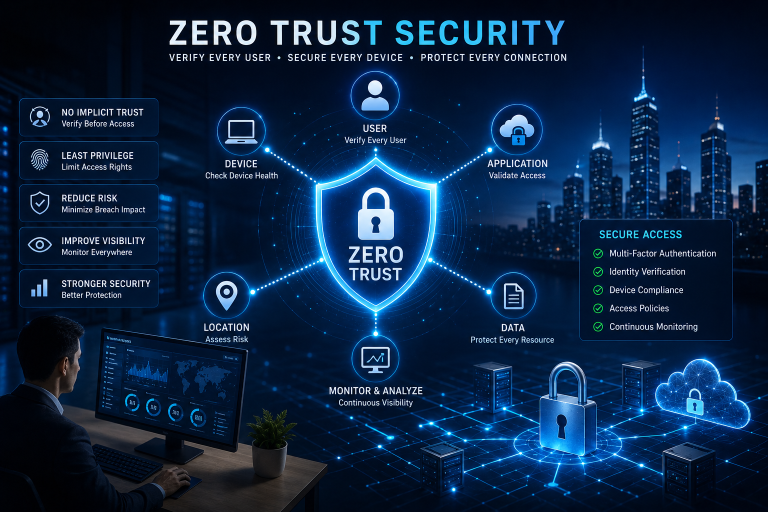
Zero Trust is an important component of modern SASE architectures.
Instead of automatically trusting users or devices based on their network location, Zero Trust requires access to be evaluated based on identity, device posture, application, context, and security policies.
This approach helps organizations reduce unnecessary access and create more granular controls.
For example, an employee may be allowed to access a specific business application without receiving unrestricted access to the entire corporate network.
Combining SASE with Zero Trust principles can provide organizations with a more flexible and security-focused approach to modern enterprise connectivity.
When Should Businesses Consider SASE?
SASE can be particularly valuable for organizations experiencing several modern networking challenges.
Distributed Employees
Hybrid and remote employees require secure access to applications without depending entirely on traditional VPN infrastructure.
Multiple Branch Locations
Organizations operating across multiple offices can benefit from centralized policy management and software-defined connectivity.
Cloud-Based Applications
Businesses using Microsoft 365, Salesforce, AWS, Azure, Google Cloud, and other cloud services need security architectures designed around cloud access.
Complex Security Infrastructure
Organizations managing numerous independent security products may benefit from consolidating networking and security capabilities.
Global Operations
International organizations require consistent connectivity and security policies across geographically distributed locations.
Key Benefits of a SASE Approach
A well-designed SASE architecture can provide several business benefits.
Improved Security
Security policies can be applied consistently across users, devices, applications, and locations.
Better Network Performance
Intelligent connectivity and distributed security services can reduce unnecessary traffic backhauling.
Simplified Management
Integrated networking and security capabilities can reduce operational complexity.
Greater Scalability
Cloud-based infrastructure can make it easier to support new employees, branches, applications, and locations.
Improved Visibility
Centralized management provides IT teams with better insight into connectivity, applications, and security events.
How Qsera Helps Enterprises Modernize Network Security
Modernizing enterprise networking requires more than simply deploying new security technology. Organizations need a connectivity strategy that considers performance, security, scalability, resilience, and long-term business objectives.
Qsera provides enterprise connectivity and networking solutions designed to support modern business environments.
Our capabilities include:
SD-WAN Services
Dedicated Internet Access
MPLS Connectivity
Ethernet Services
Fiber Connectivity
Fixed Wireless Access
Managed LEO Connectivity
Global Network Solutions
Managed Network Services
Qsera can help organizations evaluate their existing network architecture, identify connectivity and security challenges, and develop a more resilient infrastructure aligned with their business requirements.
Conclusion
The shift from traditional network security toward SASE reflects a broader change in how modern enterprises operate.
Users are distributed, applications are increasingly cloud-based, and business infrastructure extends across multiple locations and environments. Security strategies must therefore evolve beyond a fixed network perimeter.
SASE provides an approach that combines networking and security capabilities while supporting secure access, cloud adoption, distributed operations, and scalable enterprise connectivity.
For organizations planning their next-generation network, the goal should not simply be to replace existing technology. Instead, businesses should evaluate which architecture can deliver the right balance of security, performance, scalability, visibility, and operational efficiency.
With the right strategy and connectivity partner, enterprises can build infrastructure that is prepared not only for today’s requirements but also for the demands of tomorrow.
Frequently Asked Questions
Common questions about this topic.
SASE, or Secure Access Service Edge, is a cloud-centric networking and security architecture that combines capabilities such as SD-WAN, Zero Trust Network Access, secure web gateways, cloud security, and firewall services.
Traditional network security generally focuses on protecting a centralized corporate perimeter, while SASE is designed to provide secure access to applications and resources regardless of where users, devices, or applications are located.
Yes. SASE is designed to support distributed users and can provide secure, policy-based access to applications without requiring all traffic to pass through a centralized corporate network.
Zero Trust strengthens SASE by ensuring that access decisions are based on factors such as user identity, device security, application, and context rather than automatically trusting users because they are connected to a corporate network.
Yes. Qsera provides enterprise connectivity solutions including SD-WAN, Dedicated Internet Access, MPLS, Ethernet, Fiber, Fixed Wireless, Managed LEO Connectivity, and global networking solutions to help businesses build secure, scalable, and resilient infrastructure.
Ready to Build a Better Network?
Talk to Qsera's enterprise networking experts about the right connectivity solution for your business.
More insights on enterprise networking and connectivity.
UncategorizedAugust 25, 2026 5 min read
Zero Trust Network Security: How Modern Enterprises Can Secure Every User, Device, and Connection
Introduction Enterprise networks are no longer limited to employees working from a corporate office. Employees connect from branch offices, homes, public networks, mobile devices, and cloud environments every day. At the same time, businesses depend on SaaS applications, cloud platforms, connected devices, and third-party services. This expanded digital environment has made traditional perimeter-based security increasingly […]
UncategorizedAugust 20, 2026 6 min read
Network Automation in 2026: How Enterprises Can Build Smarter, Faster, and More Reliable Networks
Introduction Enterprise networks are becoming increasingly complex. Businesses now operate across multiple offices, cloud platforms, data centers, remote locations, applications, and connected devices. Managing this infrastructure manually can become time-consuming and difficult to scale. IT teams may spend significant time configuring devices, troubleshooting connectivity problems, monitoring traffic, and responding to repetitive network issues. Network automation […]
UncategorizedAugust 18, 2026 8 min read
Fast Internet Isn’t Enough: The Hidden Network Problems Slowing Down Your Business
Introduction A fast internet connection sounds like the obvious solution to a slow business network. But in modern enterprise environments, bandwidth is only one part of the performance equation. A business can have a high-speed internet connection and still experience slow cloud applications, delayed video calls, poor VoIP quality, inconsistent application performance, and frustrating connectivity […]