Traditional network security was built around a simple assumption: users and devices inside the corporate network could generally be trusted. As businesses move to cloud applications, SaaS platforms, remote work, and distributed infrastructure, this approach is no longer enough.
Modern organizations need security that continuously verifies users, devices, applications, and network activity instead of automatically trusting anything based on its location.
This is where Zero Trust Networking comes in.
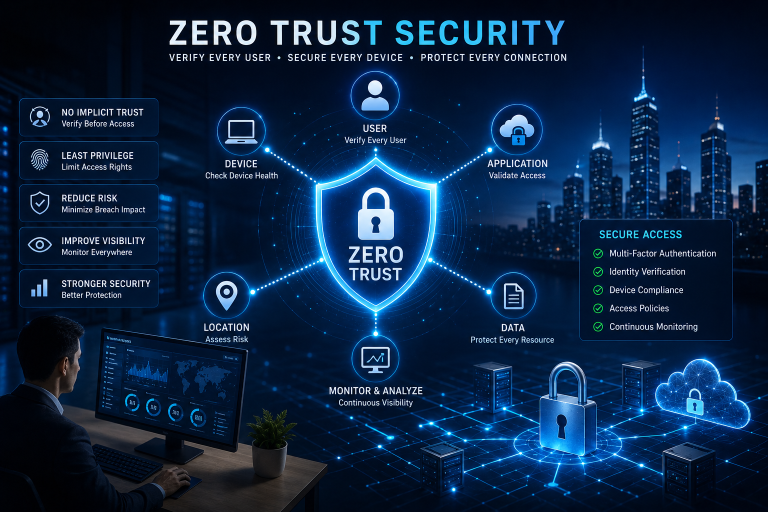
Zero Trust follows a simple principle: never trust by default, always verify before granting access. By combining identity verification, least-privilege access, network segmentation, continuous monitoring, and strong security controls, businesses can reduce their attack surface and protect critical resources.
In this guide, we explain what Zero Trust Networking means, why traditional security models are becoming less effective, and how enterprises can build a stronger Zero Trust network strategy.
What Is Zero Trust Networking?
Zero Trust Networking is a security approach that assumes no user, device, application, or connection should automatically be trusted.
Instead of granting broad network access after authentication, Zero Trust continuously evaluates whether access should be allowed based on factors such as user identity, device security, application requirements, location, access privileges, security policies, and real-time activity.
Every access request must be verified before a user or device can reach a specific resource.
This approach helps organizations protect sensitive applications and data even when users work remotely or access cloud-based infrastructure.
Why Traditional Network Security Is No Longer Enough
Traditional enterprise networks often rely on perimeter-based security.
Once a user successfully enters the corporate network, they may receive access to multiple internal resources. This creates a major security risk if an account or device becomes compromised.
Modern businesses have much more complex environments involving remote employees, cloud applications, SaaS platforms, multiple office locations, mobile devices, third-party users, IoT devices, and hybrid infrastructure.
The traditional network perimeter has effectively disappeared.
Attackers can potentially exploit stolen credentials, compromised devices, vulnerable applications, or unauthorized access to move deeper into an organization’s infrastructure.
Zero Trust reduces this risk by limiting access to only what each user and device actually needs.
Core Principles of Zero Trust Networking
Verify Every User and Device
Authentication should not be a one-time event.
Organizations should continuously verify users and devices before allowing access to sensitive applications and resources.
Multi-factor authentication, device verification, and identity-based policies can significantly strengthen access security.
Apply Least-Privilege Access
Users should receive only the access required to perform their job.
For example, an employee who only needs access to a specific business application should not automatically have access to an entire corporate network.
Least-privilege access reduces the potential damage caused by compromised accounts.
Segment the Network
Network segmentation separates critical systems and applications into controlled security zones.
If an attacker gains access to one part of the infrastructure, segmentation can prevent them from freely moving throughout the entire network.
Continuously Monitor Network Activity
Zero Trust requires ongoing visibility.
Organizations should monitor authentication events, device behavior, application access, traffic patterns, and unusual activity.
Continuous monitoring helps security teams identify potential threats before they become major incidents.
Protect Every Connection
Whether a user connects from an office, home, airport, or another location, security policies should remain consistent.
Access should depend on identity, device security, application requirements, and policy rather than simply the user’s physical location.
Benefits of Zero Trust Networking
Improved Security
Zero Trust reduces unnecessary network access and limits the potential impact of compromised accounts and devices.
Reduced Attack Surface
By restricting access to specific resources, organizations make it more difficult for attackers to move laterally through the network.
Better Remote Access Security
Remote employees can securely access business applications without receiving unnecessary access to the internal network.
Stronger Cloud Security
Zero Trust works well with cloud environments where applications and data are distributed across multiple platforms.
Improved Compliance
Detailed access policies, authentication controls, monitoring, and activity logs can help organizations meet security and compliance requirements.
Greater Visibility
Security teams gain better visibility into who is accessing resources, from which devices, and under what conditions.
How Qsera Can Help Businesses Implement Zero Trust
Building a Zero Trust network requires more than simply deploying a security product. It requires a strategic approach that combines connectivity, identity, network architecture, monitoring, and cybersecurity.
Qsera helps businesses design and implement secure enterprise networking environments that support modern Zero Trust principles.
Our networking capabilities include Dedicated Internet Access, SD-WAN, MPLS connectivity, Managed Network Services, cloud connectivity, cybersecurity integration, network monitoring, and business continuity solutions.
Our team can assess your existing infrastructure, identify security and connectivity gaps, and develop a network architecture designed around secure and controlled access.
The goal is simple: give users the access they need while protecting everything they don’t.
Steps to Begin a Zero Trust Strategy
Identify Critical Resources
Determine which applications, systems, and data require the highest level of protection.
Identify Users and Devices
Create visibility into who is accessing business resources and which devices they are using.
Implement Strong Authentication
Adopt multi-factor authentication and stronger identity controls.
Apply Least-Privilege Policies
Limit access according to job responsibilities and business requirements.
Segment Critical Infrastructure
Separate sensitive systems from general network resources.
Monitor Continuously
Track network activity and investigate unusual behavior.
Review and Improve Policies
Regularly evaluate access policies as users, applications, and infrastructure change.
Conclusion
The traditional idea of securing a network perimeter is no longer sufficient for modern enterprises.
With employees working remotely, applications moving to the cloud, and business infrastructure becoming increasingly distributed, organizations need a security model that continuously verifies access.
Zero Trust Networking provides that foundation.
By implementing strong identity verification, least-privilege access, network segmentation, continuous monitoring, and secure connectivity, businesses can create a more resilient and secure digital infrastructure.
Qsera helps enterprises build modern networking environments designed for security, scalability, reliability, and long-term digital growth.
Frequently Asked Questions
Common questions about this topic.
Zero Trust Networking is a security approach where users, devices, applications, and connections are not automatically trusted. Every access request is verified according to identity, security policies, device status, and other relevant factors.
Traditional security often relies heavily on protecting the network perimeter. Zero Trust assumes that threats can exist both inside and outside the network and therefore continuously verifies access to individual resources.
No. Businesses of different sizes can adopt Zero Trust principles. Organizations can begin with important areas such as identity management, multi-factor authentication, least-privilege access, and network segmentation.
Yes, but positively. Zero Trust can provide remote employees with secure access to the specific applications and resources they need without exposing the entire corporate network.
Qsera can help businesses evaluate their existing network infrastructure and implement secure connectivity solutions including SD-WAN, Dedicated Internet Access, managed networking, cloud connectivity, monitoring, and cybersecurity integration to support a Zero Trust strategy.
Ready to Build a Better Network?
Talk to Qsera's enterprise networking experts about the right connectivity solution for your business.
More insights on enterprise networking and connectivity.
UncategorizedAugust 25, 2026 5 min read
Zero Trust Network Security: How Modern Enterprises Can Secure Every User, Device, and Connection
Introduction Enterprise networks are no longer limited to employees working from a corporate office. Employees connect from branch offices, homes, public networks, mobile devices, and cloud environments every day. At the same time, businesses depend on SaaS applications, cloud platforms, connected devices, and third-party services. This expanded digital environment has made traditional perimeter-based security increasingly […]
UncategorizedAugust 20, 2026 6 min read
Network Automation in 2026: How Enterprises Can Build Smarter, Faster, and More Reliable Networks
Introduction Enterprise networks are becoming increasingly complex. Businesses now operate across multiple offices, cloud platforms, data centers, remote locations, applications, and connected devices. Managing this infrastructure manually can become time-consuming and difficult to scale. IT teams may spend significant time configuring devices, troubleshooting connectivity problems, monitoring traffic, and responding to repetitive network issues. Network automation […]
UncategorizedAugust 18, 2026 8 min read
Fast Internet Isn’t Enough: The Hidden Network Problems Slowing Down Your Business
Introduction A fast internet connection sounds like the obvious solution to a slow business network. But in modern enterprise environments, bandwidth is only one part of the performance equation. A business can have a high-speed internet connection and still experience slow cloud applications, delayed video calls, poor VoIP quality, inconsistent application performance, and frustrating connectivity […]